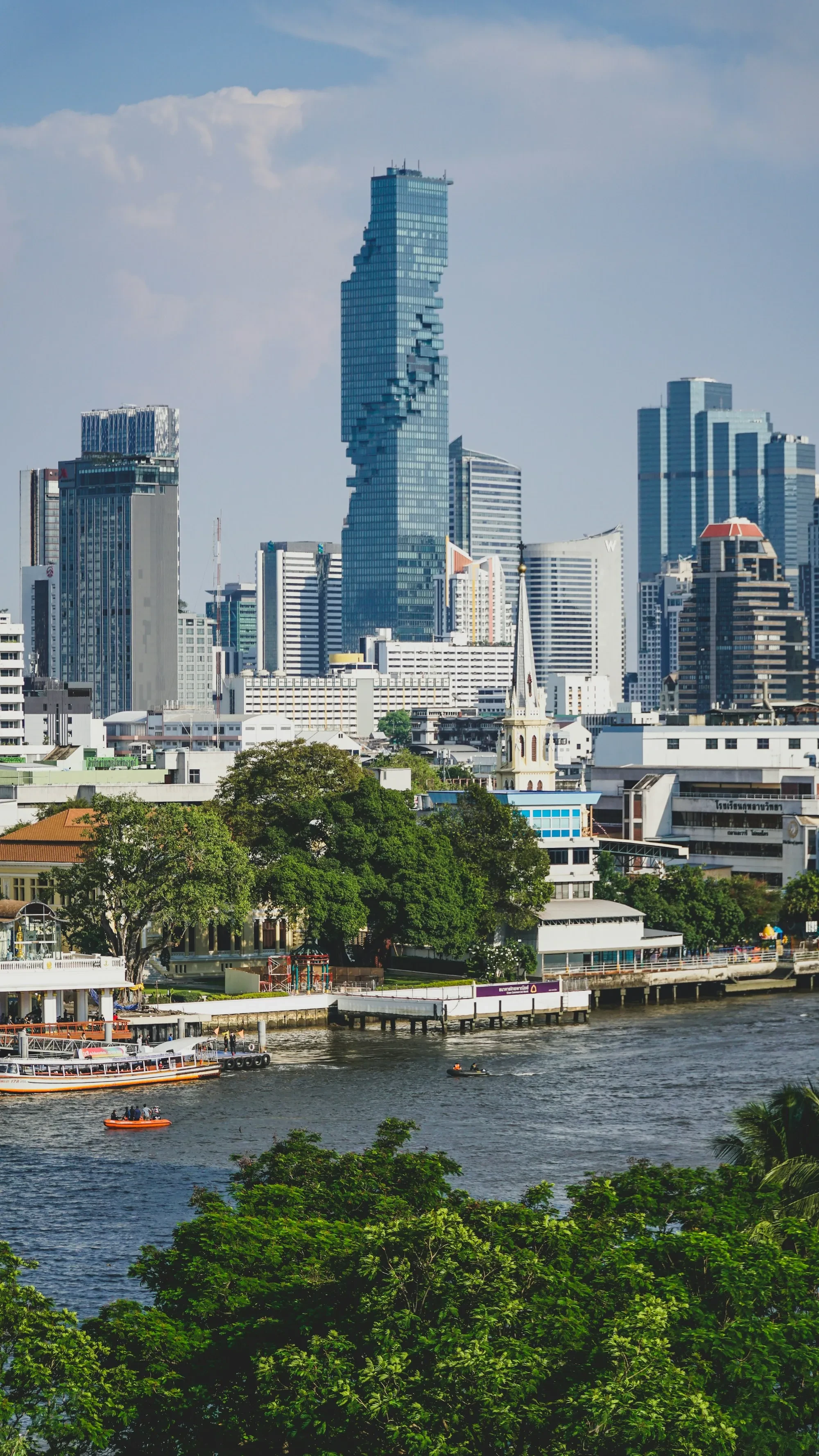
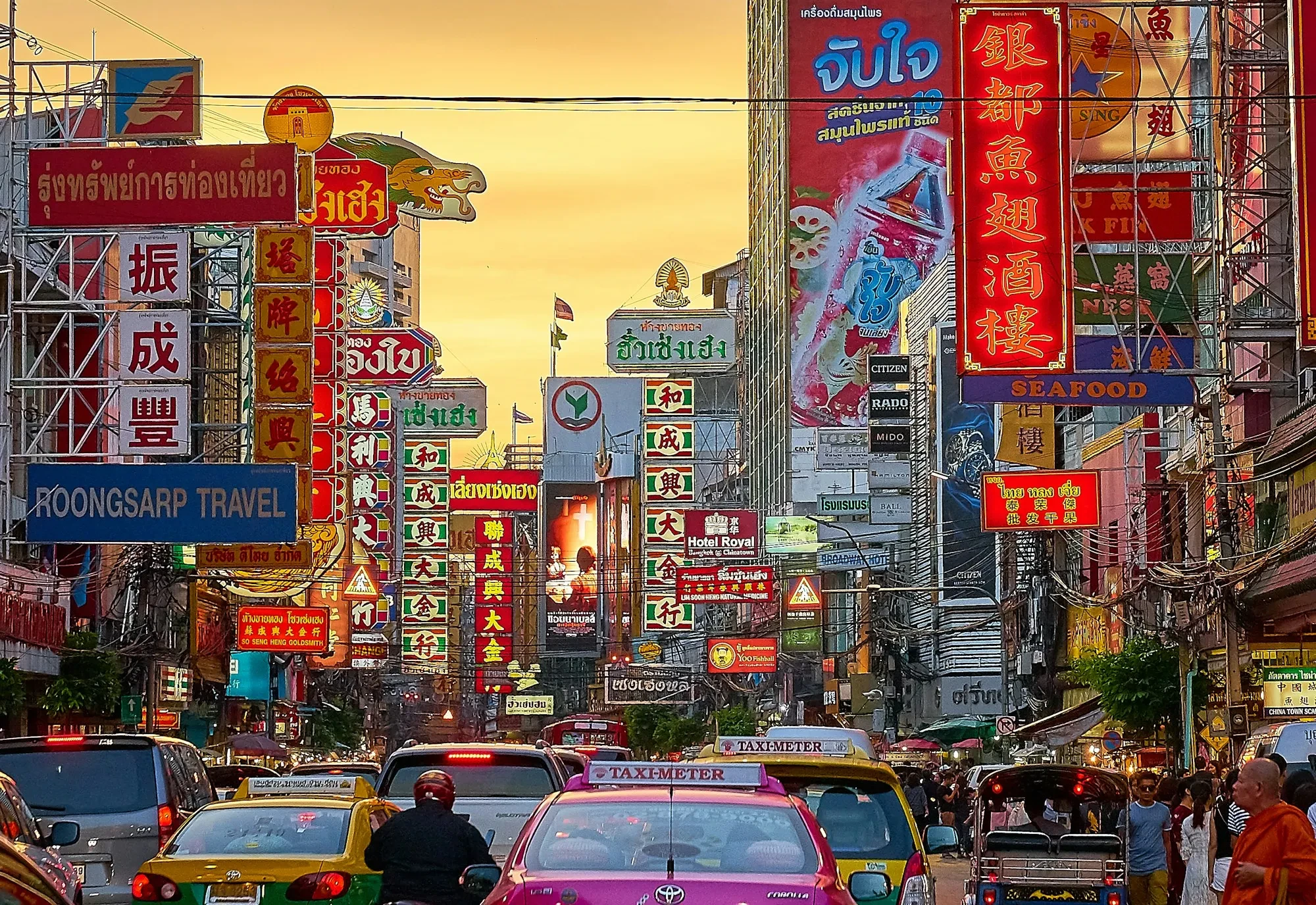
Bangkok sits on a flat alluvial plain at the head of the Gulf of Thailand, with the Chao Phraya River bisecting the city north-south for 21 kilometers. The metropolitan area holds 17 million people across 1,569 square kilometers of urban sprawl that absorbs more than 32 million foreign visitors a year, more than any other city on earth. Three days covers the Old City and Sukhumvit; add 2 more for Ayutthaya and the floating markets.
🕐
Best Time
November-February
💴
Currency
Thai Baht (THB)
🗣️
Language
Thai; English widely spoken in tourist areas, hotels, and on BTS/MRT signs
🚇
Transport
BTS Skytrain, MRT, Chao Phraya boat, Taxi
🌡️
Climate
Tropical; hot year-round, monsoon May-October
Bangkok has two airports. Suvarnabhumi (BKK) is 30 km east of the city center and handles 95% of international arrivals. The Airport Rail Link City Line is the fastest and cheapest connection: take it from the Suvarnabhumi station at Level B1 to Phaya Thai for $1.30, then transfer to the BTS Sukhumvit Line. The full journey to a Sukhumvit hotel takes 35-45 min. A metered taxi from the official airport queue on Level 1 costs $10-15 to most central neighborhoods, including the $1.40 airport surcharge and tolls. Grab and Bolt both operate; an airport-to-Asok pickup runs $10-18. The trap: drivers at the kerb outside arrivals demand a $20-28 fixed fare and refuse to switch on the meter. Walk past them to the public taxi rank at Gate 4 or 7 on Level 1 and collect the printed dispatch slip from the kiosk before boarding. Don Mueang (DMK) handles most AirAsia and Nok Air flights; the A1 bus from the terminal to BTS Mo Chit costs $1 and takes 20-30 min in normal traffic.
Bangkok runs three separate rail systems: the BTS Skytrain (elevated, Sukhumvit and Silom Lines), the MRT (subway, Blue and Purple Lines), and the Airport Rail Link. They share major interchanges but charge separate fares unless you tap with a contactless Visa or Mastercard, which works across MRT, BTS Gold, and the SRT Red Line. BTS single rides cost $0.50-1.90 by distance; the One-Day Pass is $4.30 and pays off after 4 rides. Buy a Rabbit Card at any BTS ticket office ($6 issue + $3 starting credit) if you will be in town more than 3 days. The Chao Phraya Express orange-flag commuter boat is the fastest way along the river: a single ride costs $0.45 and the route stops at Wat Arun, Grand Palace pier (Tha Chang), and Yaowarat. The blue-flag tourist boat day pass at $4.30 runs the identical route 5 min apart. Validate by tapping in and out at the turnstiles; the MRT inspects randomly and fines $14 for invalid taps. Use Google Maps for routing; it shows live train times in English. Ride-hail: Grab and Bolt both work city-wide; a 5 km cross-city fare runs $4-8 and rises 50-80% during the 7-9am and 5-8pm jams. Skip tuk-tuks for any distance over 1 km. They cost more than a metered taxi and refuse the meter. Avoid unmarked taxis around tourist sites; just walk to the next cab if a driver refuses the meter.
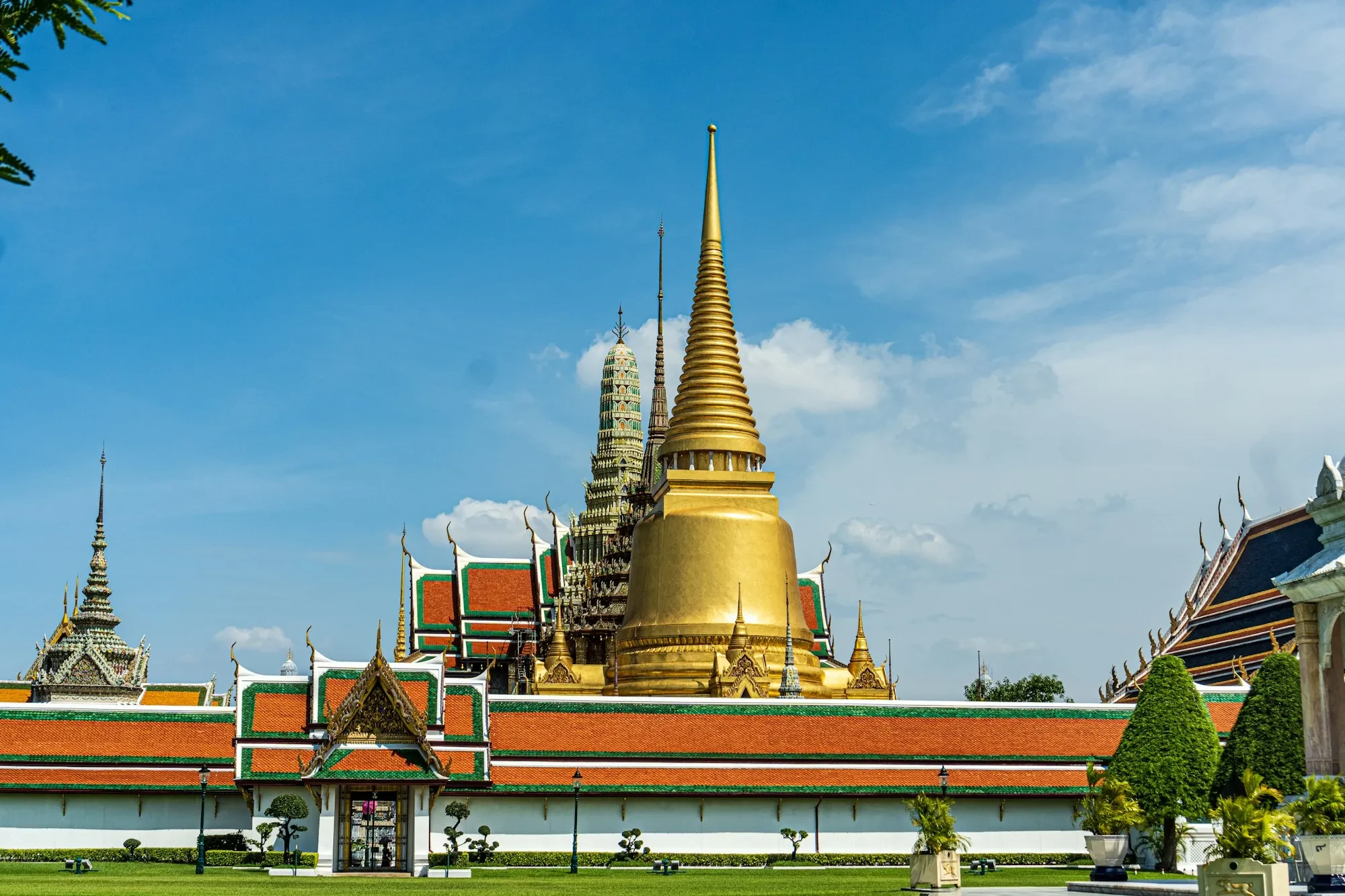
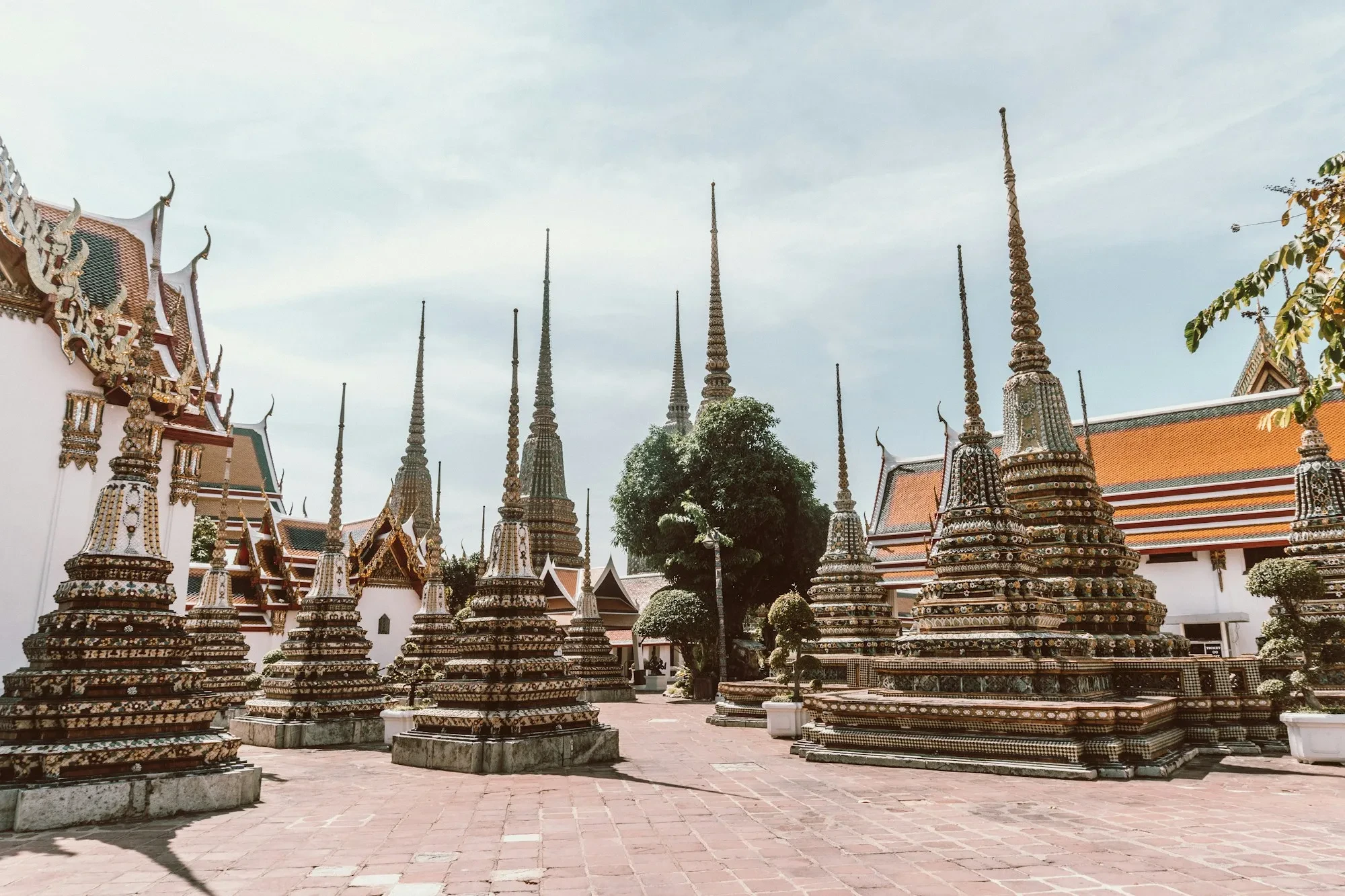
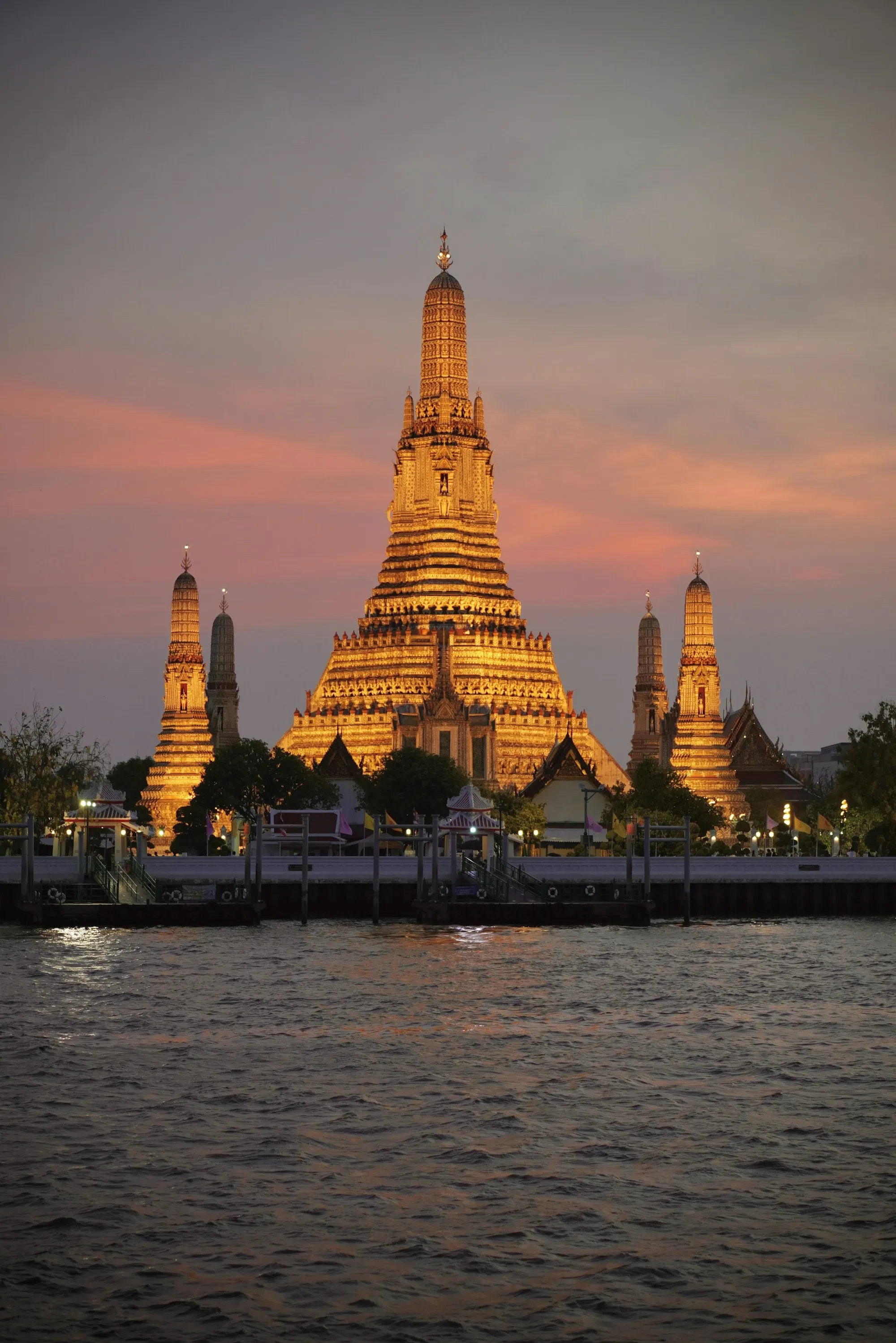
Bangkok's Old City was raised on the east bank of the Chao Phraya in 1782 when Rama I moved the Siamese capital across the river from Thonburi. The Grand Palace complex covers 218,400 square meters and held the royal residence until 1925; its central Wat Phra Kaew shelters the 66-cm Emerald Buddha, carved from a single jadeite block, dressed in three seasonal gold costumes that the king himself changes by hand each season. Wat Pho, 400 meters south along Sanam Chai Road, contains the 46-meter Reclining Buddha covered in gold leaf and inlaid with mother-of-pearl on the soles of its 3-meter feet; the same complex is the birthplace of Thai massage and houses the country's first medical school. Across the river by 5-min ferry, Wat Arun's central prang rises 70 meters, encrusted with porcelain shards that 19th-century Chinese trading vessels offloaded as ballast. The skyline visible from those Old City viewpoints stretches 12 km east into Sukhumvit, where the 314-meter MahaNakhon tower and the 78-storey King Power MahaNakhon mark the new center of gravity for a city that absorbs 50,000 new residents every year.
-
Pad Thai Goong
$2-4
Stir-fried rice noodles with tamarind, palm sugar, fish sauce, dried shrimp, and fresh prawns. Finished with crushed peanuts, lime, bean sprouts, and a wedge of green papaya at the table.
The wok-station stalls in front of Thip Samai on Mahachai Road in the Old City, or any sidewalk cart along Yaowarat Road after 7pm
-
Khao Man Gai
$2-3.50
Poached chicken on rice cooked in chicken fat and ginger, served with a fermented soybean and chili dip and a small bowl of clear broth on the side. Specify breast meat (sliced from the steam tray) for tenderness.
Go-Ang Pratunam Khaomankai on Petchaburi Soi 30, open since 1960; queues move in 15 min
-
Tom Yum Goong
$3-5
Hot-and-sour shrimp soup with lemongrass, kaffir lime leaf, galangal, bird's-eye chilies, and lime. The nam khon version adds coconut milk; nam sai stays clear. Each bowl holds two whole river prawns.
Lokanta-style canteens along Charoenkrung Road in the Old City, or the food courts inside MBK Center and Terminal 21 mall
-
Som Tam Thai
$1.50-3
Green papaya pounded to order in a clay mortar with cherry tomato, long bean, peanut, dried shrimp, palm sugar, fish sauce, and lime. Ask for noi prik (less chili) if you do not want the default heat.
Som Tam Nua at Siam Square Soi 5 (Siam BTS Exit 4), or any cart inside Or Tor Kor Market next to Chatuchak
-
Mango Sticky Rice (Khao Niao Mamuang)
$2-3.50
Glutinous rice steamed and soaked in salted coconut cream, served with half a ripe yellow Nam Dok Mai mango on the side. Peak mango season runs March-June.
Mae Varee on Sukhumvit Soi 55 (Thong Lor BTS Exit 3), or any dessert cart inside Or Tor Kor Market
The major tourist zones of Rattanakosin (Old City), Sukhumvit around Asok and Phrom Phong, Silom near Lumphini Park, Sathorn, and Siam Square are safe to walk during daylight and at night. Avoid the wholesale market alleys around Khlong Toei and the deep sois south of Lat Phrao after dark. Three active scam patterns: (1) Outside the Grand Palace, an English-speaking man in business clothes claims the palace is closed for a Buddha day or royal ceremony and waves down a waiting tuk-tuk for a discount city tour. The tuk-tuk circuit ends at commission-paying gem stores and tailors. The Grand Palace opens 8:30am-3:30pm every day. Walk straight to the official ticket gate at the south end of Sanam Luang field. (2) Metered taxis near tourist sites refuse the meter and quote a $5.50-8.50 flat fare for a 5 km ride. Walk to the nearest BTS or open Grab on your phone; the legal meter rate is $1 flag-fall and $0.18 per km. (3) Tuk-tuk drivers offer a $0.55 sightseeing loop that ends at gem shops where the driver collects a per-head commission worth more than the ride. Never accept a sub-$3 tuk-tuk fare for more than one stop. Solo female travel: BTS and MRT trains have a women-only car at the front during rush hours, marked with a pink sign on the platform. The Tourist Police hotline is 1155 (24/7, English-speaking). Bangkok Hospital: 2 Soi Soonvijai 7, New Petchburi Road; nearest MRT: Phetchaburi (10-min walk). US Embassy Bangkok: 95 Wireless Road; nearest BTS: Phloen Chit (3-min walk).
Rattanakosin (Old City) puts you within walking distance of the Grand Palace, Wat Pho, and the Chao Phraya boat piers; the area runs quiet after 9pm with limited dinner options and no BTS access, meaning taxi or tuk-tuk for any cross-city move. Sukhumvit around Asok, Phrom Phong, and Thong Lor sits on the BTS Sukhumvit Line with the densest cluster of mid-range hotels, full-size supermarkets, and air-conditioned malls; two skytrain stops from Siam and four from the Chao Phraya ferries. Silom around Sala Daeng connects to both BTS lines at the Sala Daeng interchange and borders the 57-hectare Lumphini Park; expect business-hotel pricing and weekday lunch crowds. Riverside near Saphan Taksin BTS and Sathorn pier offers direct Chao Phraya Express access to the Old City temples in 20-30 min; pier-front room rates run 40-60% above interior Silom blocks. Siam Square at the BTS Siam interchange between both Skytrain lines puts you next to MBK Center, Siam Paragon, and Jim Thompson House; expect dense traffic and the noisiest commercial pavement in central Bangkok.
- Visa: 60-day visa exemption applies to US, UK, EU, Canadian, Australian, and most major-market passports on arrival. Passport must be valid for at least 6 months past your entry date. The mandatory Thailand Digital Arrival Card (TDAC) replaced the paper TM6 in 2025: complete it free at tdac.immigration.go.th within 72 hours of arrival and keep the QR code on your phone for the immigration officer to scan.
- eSIM: AIS, dtac, and TrueMove H are all on Airalo from $7 for 10 GB / 30 days. A physical tourist SIM at the airport AIS counter runs $10-15 with passport; the same SIM at any 7-Eleven costs $5.70 and activates faster than the airport queue.
- Power: Type A (US flat 2-pin), Type C (EU round), and Type O (Thai 3-pin) all share the same Thai socket. 220V/50Hz. US devices not rated 100-240V need a step-down converter, not just an adapter.
- Cash: Krungthai, Bangkok Bank, and Kasikorn ATMs all charge a $6 foreign-card fee per withdrawal; withdraw the $700 maximum in one transaction to dilute the fee. Always choose the local currency at the terminal when prompted; selecting your home currency adds 3-5% in dynamic conversion. Street food, taxis, and tuk-tuks are cash only; mid-range and above accept card.
- Advance bookings: Grand Palace timed entry is recommended Dec-Feb (book at royalgrandpalace.th); Jim Thompson House sells tickets only at the gate (no online); Ayutthaya day tours fill 1-3 days ahead in peak season.
- Backpacker ($35-55/day): hostel dorm $8-15, BTS day-pass $4.30, two street meals $4-7, one paid sight $8-15.
- Mid-range ($75-120/day): 3-star hotel in Sukhumvit or Silom $35-65, mixed BTS and Grab transport $8-15, three meals at street stalls and food courts $15-25, two paid sights $15-30.
- Comfort ($180-300/day): riverside or 4-star hotel $100-180, taxi and Grab transport $20-40, sit-down restaurants $40-80, premium experiences $20-50.
- November-February: cool dry season. 22-32°C, 0-2 rain days/month, peak crowds and peak prices. Book hotels 4-6 weeks out for December and Christmas-New Year.
- March-April: hot season. 33-40°C, low humidity, lowest crowds outside the Songkran water festival window (April 13-15) when most central streets close for the citywide water fight.
- May-October: monsoon season. 30-34°C with daily afternoon downpours (typically 30-60 min) and 10-18 rain days/month. Hotel rates drop 30-40%; covered malls and the BTS are the rain-day fallback.
- Best month: December (stable dry weather, full event calendar). Worst month: April (peak heat plus Songkran street closures).
- Cheapest flights: book 6-10 weeks ahead; Tuesday and Wednesday departures from US/EU undercut weekend flights by $80-150.
- Maeklong Railway Market: 1.5 hr by minivan from Victory Monument BTS ($3 one-way) or 2 hr by SRT train from Wongwian Yai. Vendors retract awnings four times daily (8:30am, 11:10am, 2:30pm, 5:40pm) as the train threads the live track. Half-day enough; commonly paired with Damnoen Saduak.
- Ayutthaya (old Siamese capital): 1.5-1.75 hr intercity train from Krung Thep Aphiwat. $1 ordinary class, $6 second-class express, $20 round-trip first class. Six-temple combined ticket $6. Rent a station-side bicycle for $2/day to cover the ruins. Full day; last comfortable train back at 6pm.
- Damnoen Saduak Floating Market: 2 hr by minivan from Victory Monument ($3 one-way). Long-tail boat rides at the market are $20 for 1 hr; rowed sampan boats are $11. Honest verdict: arrive by 7:30am. By 10am the canal is bumper-to-bumper tourist boats and the working vendors have already left.
The current reality in Bangkok is that a Visa or Mastercard contactless tap now works directly on the MRT Blue, Purple, Yellow, Pink lines and the SRT Red Line, but not on the original BTS Sukhumvit and Silom lines, which still require a Rabbit Card or a paper single ticket. Holding both a Rabbit Card and a contactless bank card covers every rail system in the city without queueing at a ticket machine. A 7-Eleven on every block now sells the same AIS or TrueMove tourist SIM the airport kiosks push for $10-15 at a flat $5.70; staff swap the SIM and activate the 30-day data plan in 5 min. The orange-flag commuter Chao Phraya boat from Sathorn to Phra Athit pier still costs $0.45 and stops at Wat Arun and Grand Palace, three times cheaper than the blue-flag tourist boat that runs the identical route 5 min apart with a guide on board. The Or Tor Kor produce market next to Chatuchak (MRT Kamphaeng Phet exit 3) is open daily, not just weekends, and undercuts Chatuchak prices on the same Som Tam, mango sticky rice, and durian by 30-40%.
Must Visit
Grand Palace & Wat Phra Kaew
Built in 1782 as the residence of Rama I and the Chakri dynasty, the 218,400-square-meter complex held the royal household until 1925 and still hosts state functions. The compound's Wat Phra Kaew shelters the 66-cm Emerald Buddha, carved from a single jadeite block; its three seasonal gold costumes are changed by the king himself each season. Entry is $14 with audio guide. Guerilla tip: arrive at 8:15 AM, 15 min before opening, to clear the ticket gate before the first tour buses. Long pants and covered shoulders required; sarongs available at the entrance with a refundable $3 deposit.
Must Visit
Wat Pho
Bangkok's oldest and largest temple complex, 400 meters south of the Grand Palace. The main hall holds the 46-meter Reclining Buddha covered in gold leaf, with mother-of-pearl inlay across the soles of its 3-meter feet depicting the 108 auspicious symbols. The temple compound was Thailand's first public university and remains the headquarters of the national Thai massage school. Entry is $8.50 and includes a small bottle of cold water at the gate. Guerilla tip: enter from the east gate on Sanam Chai Road, opposite Wat Pho Massage School; the south gate has the tour-bus queue. A 1-hour traditional Thai massage at the on-site school costs $13 with no booking required.
Must Visit
Wat Arun (Temple of Dawn)
A 70-meter central prang on the west bank of the Chao Phraya, encrusted with broken Chinese porcelain that 19th-century trading ships offloaded as ballast. The prang faces east, so its tiles catch the first light at dawn; that is the source of its name. Entry is $5.50. Guerilla tip: cross from Tha Tien pier on the Old City side for $0.15 on the cross-river shuttle ferry, not the tourist boat. Climb only to the second tier; the upper steps are 70° steep and have no handrail on the prang itself. Best photo angle is from the Tha Tien side of the river at 6pm, when sunset backlights the prang.
Must Visit
Yaowarat (Chinatown)
Bangkok's densest food street, running 1.5 km from Odeon Circle east through the heart of the Sampheng district. The neon-signed shophouses date from the 1920s and are owned by the same Teochew-Chinese families that opened them. Street stalls take over the entire Yaowarat Road from 6pm to midnight every night except Monday. Free to walk. Guerilla tip: take the MRT Blue Line to Wat Mangkon station, exit 3, and walk one block south to land at the cross-street of T&K Seafood and the Heng Heng beef noodle stall. Bring small-denomination cash ($0.55 and $3 notes); no vendor here takes card. The side alley Phadungdao runs the better seafood-grill stalls at half the price of Yaowarat Road frontage.
- Tipping: rounding up to the nearest $0.55 is standard at sit-down restaurants; 10% is generous if no service charge is listed. Many sit-down places add a 10% service charge automatically; check the bill before adding more. Not expected at street food, food courts, or in taxis (round up only).
- Tap water: not safe to drink. A 600 ml bottle at 7-Eleven costs $0.30; tourist-area mini-marts at the Grand Palace gate charge $1. Refill from your hotel water dispenser or carry a reusable bottle.
- Dress code at temples: covered shoulders and knees required at Grand Palace, Wat Phra Kaew, Wat Pho, and Wat Arun. No flip-flops on bare feet; either trainers or sandals worn with socks. Sarongs available at Grand Palace and Wat Arun entrances with refundable deposit ($3 and $0.55 respectively).
- Dress code in the city: shorts and sleeveless tops fine everywhere outside temples and government offices.
- Grand Palace entry: $14 with audio guide, 8:30am-3:30pm, last ticket 2:30pm. The audio guide is the only way to identify the murals; the printed signage is fragmentary.
- Public toilets: free at BTS/MRT stations and inside every mall; street-side and market toilets charge $0.15-0.30.
- Card vs. cash: card accepted at hotels, supermarkets, mall food courts, and chain restaurants. Carry $14-28 cash daily for street food, taxis, tuk-tuks, and temple entry fees.