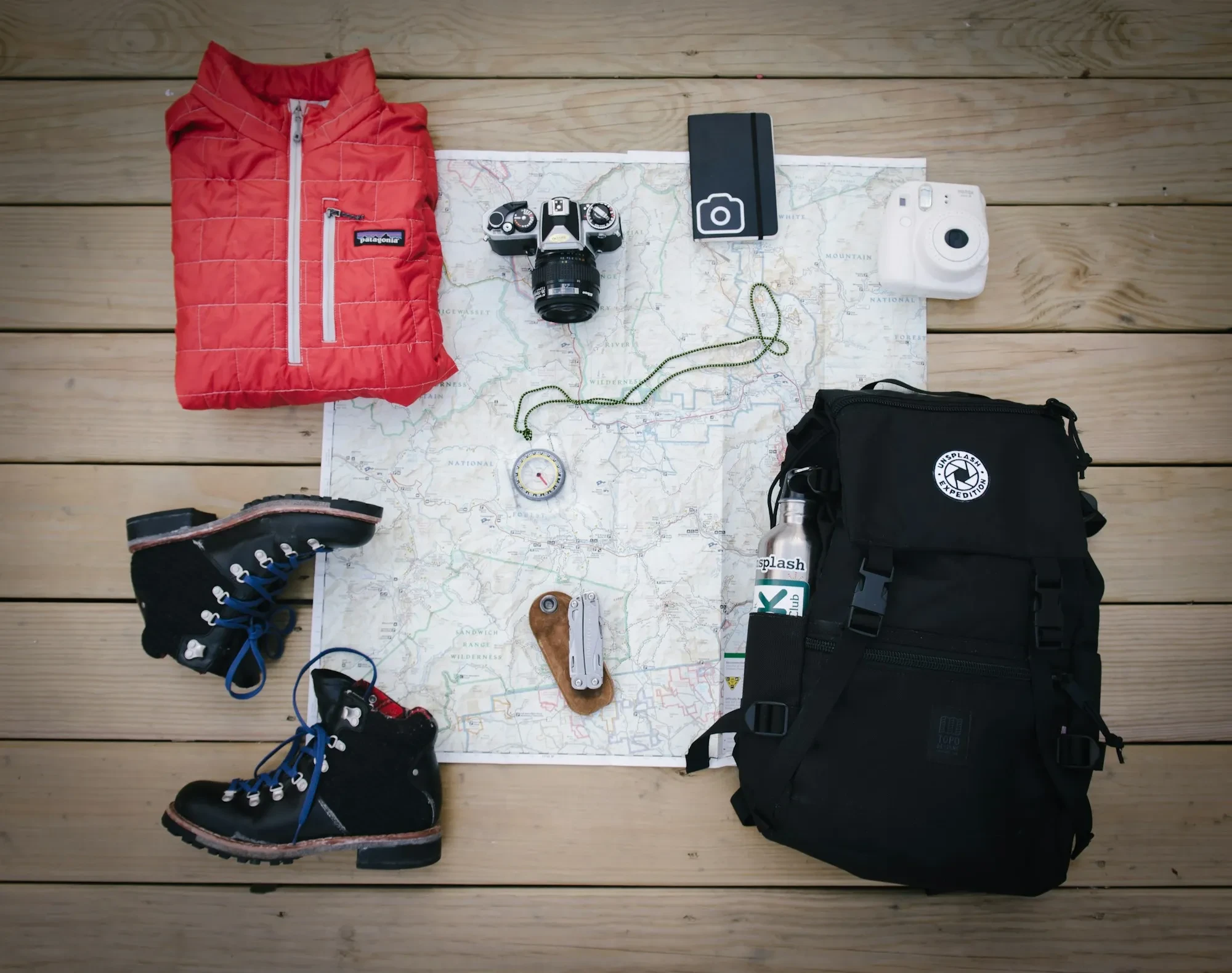
Two weeks fit in a 40-liter carry-on bag if every item of clothing pairs with every other item. A system of 5 tops, 3 bottoms, 2 pairs of shoes, and 1 jacket covers 14 days without outfit repetition when all tops share a neutral base color (navy, grey, white, or black). Carry-on-only travel eliminates checked bag fees of $30 to $70 per leg on most carriers, removes baggage claim wait time, and ends lost luggage as a risk. The constraint is not the trip length; it is the airline's size limit, which ranges from 40x20x25 cm on Ryanair to 56x36x23 cm on most full-service carriers.
- Use the 5-4-3-2-1 framework: 5 pairs of socks and underwear, 4 tops, 3 bottoms, 2 pairs of shoes, 1 jacket or outer layer. Keep all tops in one color family so every combination is wearable without a mismatch.
- Prioritize merino wool for tops: one merino t-shirt ($50 to $120 from Uniqlo, Icebreaker, or Smartwool) can be worn 3 to 4 days without absorbing odor the way cotton does. This is the largest single space multiplier in carry-on packing.
- Shoes are the heaviest category. Wear the bulkiest pair on the plane; pack one lighter pair in the bag. Running shoes work as walking shoes for most city itineraries. A third pair is almost never necessary for trips under 21 days.
- Never pack just-in-case items: a spare formal outfit for a dinner that might happen, a rain jacket if the forecast shows clear skies, or dress shoes for one possible evening. Each adds 300 to 600 grams and takes 1 to 3 liters of space.
- Every fabric item must be quick-dry: if a garment takes more than 8 hours to dry, you cannot wash it in a sink and wear it the next morning. Check the label before packing.
The plane is the most underused tool in carry-on packing. Wear the heaviest items on travel days: your thickest jacket, your largest shoes, your bulkiest trousers. What stays in the bag becomes lighter and compresses more. Most flights now run cold regardless of outside temperature, so a warm layer worn on board is practical, not a sacrifice. One rule most packing guides skip: always put non-replaceable items in your personal item (the under-seat bag), not in the overhead carry-on. Documents, medication, one day's change of clothes, and charging cables go in the personal item. If the airline gates your carry-on at the boarding door because overhead bins are full, gated carry-ons go into the hold. Personal items do not.
- TSA and EU aviation rules allow liquids up to 100 ml per container in a single 1-liter clear bag. Replace liquid toiletries with solid alternatives: shampoo bars ($8 to $14 from Ethique or Lush), solid sunscreen, and soap bars. This eliminates the liquids bag entirely and saves 400 ml of space.
- Use compression packing cubes: one per category (tops, bottoms, socks and underwear). Cubes with a tightening zip compress clothing by 20 to 30% and make TSA unpacking and repacking faster than loose packing.
- One 65W GaN USB-C charger ($25 to $35 from Anker or Ugreen) replaces all individual device chargers. Since the EU USB-C mandate took effect in December 2024, all phones, tablets, laptops, and wireless earphones in the EU market charge via USB-C. One charger and one cable replaces the full set.
- Download offline maps before departure over Wi-Fi. Google Maps offline covers one city at a time and requires Wi-Fi to set up. Maps.me covers entire countries offline. A pre-downloaded map costs nothing; loading Maps in real time without an eSIM can cost $5 to $15 per day on a standard roaming plan.
- Laundry strategy for trips over 10 days: book one accommodation with a washing machine, or use a self-service laundromat ($3 to $6 per load in Western Europe, $1 to $3 in Southeast Asia). Pack one Scrubba detergent packet ($0.30 per use) for daily sink washing of socks and underwear.
Budget carriers enforce carry-on size rules strictly and the gate penalty is higher than the cost of pre-paying for a bag at booking. Ryanair: the free personal item (under-seat only) must fit 40x20x25 cm. An overhead cabin bag up to 55x40x20 cm costs $10 to $24 at booking or $55 to $70 at the gate. Wizz Air: free personal item under the seat; overhead cabin bag costs $9 to $22 at booking or $50 to $75 at the gate. EasyJet: one cabin bag up to 56x45x25 cm included in all fares with no additional fee. Turkish Airlines: one cabin bag up to 55x40x20 cm plus one personal item, both included in all economy fares. The bag sizer trap: gate sizers at Ryanair and Wizz Air are calibrated to the minimum allowed dimension. A bag that fits in the overhead bin may fail the sizer if it has a rigid external frame or protruding wheels. Soft-sided bags with compression straps pass the sizer; many hard-shell carry-ons fail.
- Weigh your packed bag at home before departure: most carry-on allowances cap at 8 to 10 kg. A 40-liter bag fully loaded with shoes, a laptop, and clothing reaches 9 to 10 kg easily. Exceeding the weight limit at the gate costs $30 to $50 per direction on most budget carriers.
- Pre-pay for any bag at booking, not at the gate: the fee difference between booking online and paying at the gate is $35 to $55 per direction for Ryanair and Wizz Air. The gate price is always the maximum tier.
- At security, remove your laptop and liquids bag before reaching the conveyor. A traveler who arrives at the scanner still repacking these items causes a 2 to 4 minute delay and increases the chance of a manual inspection flag on the carry-on.
- Scam warning: luggage brands sold through social media ads frequently list dimensions that comply with budget carrier size limits on paper, but the physical bag measured at a gate sizer is 3 to 5 cm larger than advertised. Buy from brands with documented carry-on compliance records: Away, Osprey, Peak Design, or Samsonite.
- Scam warning: vacuum compression bags sold at airport duty-free stores double in size when you repack at the destination because a vacuum is not available in most hotel rooms. Compression cube zippers achieve similar volume reduction without requiring equipment you will not have.